Key takeaways
- A year-one AI search optimization program for a B2B SaaS at the $2M–$20M ARR stage costs $40k–$120k in total, with tooling as the smallest line item ($1,200–$4,260 annually) and internal strategic hours as the largest.
- AI citation visibility is a shortlist problem, not a traffic problem: 95% of B2B deals are won by a vendor already on the buyer’s Day One shortlist, according to 6Sense’s 2025 Buyer Experience Report of 3,974 buyers.
- An AI-optimized program layered onto an existing content engine accelerates that clock rather than resetting it: the payback benchmark for B2B SaaS content and SEO programs is a median 7-month break-even and 702% ROI, per First Page Sage benchmark data.
- Direct revenue attribution from AI search citations is genuinely difficult: roughly 70% of AI-referred visits arrive without referrer headers, so the CFO case is built on influenced pipeline and branded search lift, not last-click revenue.
A head of marketing at a $5M ARR B2B SaaS company has a budget review in three weeks. The board wants a line item for AI search. She opens 12 tabs, reads 12 articles, and finds the same thing in each: schema markup tips, content format advice, and a list of tools to evaluate.
None of them tells her what the program costs in year one, what it pays back, or how to defend the number to a CFO who has never heard of generative engine optimization (GEO).
That gap is what I’m fixing here.
The AI search category has no cost model calibrated to the growth stage. Agency pricing guides exist, but they’re built to justify agency retainers, which are neither the right format nor the right price point for an in-house program. Vendor blogs exist, but they’re written to sell enterprise tools to Fortune 500 buyers.
In this article, I’ll deliver a line-by-line year-one cost breakdown for a B2B SaaS company at $2M–$20M ARR, a payback model grounded in verifiable benchmarks, and a clear framework for when to invest now versus when to wait. The numbers are real. The sources are cited. The takeaway is a one-page structure you can adapt for a board doc.
One claim up front: most of this spend redirects existing content budget rather than adding to it. That distinction is what makes AI search optimization defensible to a CFO who has already approved a content function and is being asked to fund what looks like a new line item.
Why the investment window for AI search optimization is open right now
Two arguments make the year-one investment defensible. The first is about how shortlists form. The second is about how search volume is shifting. Both deserve to be presented honestly, including where the evidence is forecast rather than confirmed.
Start with shortlist formation. 6Sense’s 2025 Buyer Experience Report, based on 3,974 B2B buyers surveyed globally, found that 94% of buyers now use LLMs during vendor evaluation, and that 95% of the time the winning vendor was already on the buyer’s Day One shortlist (up from 85% the previous year).
Read those two numbers together. If the shortlist is increasingly shaped by AI-mediated research, then a company not cited in AI responses is not losing deals late in the funnel. It is being excluded from consideration before the funnel begins.
That reframes the investment question. The CFO case for AI search optimization is not “we will generate attributable leads from ChatGPT next quarter.” It is “we are at risk of being excluded from the four-vendor shortlist that decides 95% of deals in our category.”
The second argument is discovery behavior, and the data here is more straightforward. Semrush’s 17-month ChatGPT clickstream study found that ChatGPT referral traffic grew 206% year-over-year from January 2025 to January 2026, reaching approximately 170,000 unique domains.
Similarweb’s 2025 Generative AI Landscape report, published December 2025, put AI referral visits at over 1.1 billion in June 2025, up 357% year-over-year. Or Offer, Similarweb’s CEO, framed the behavioral shift directly: “The center of gravity in digital discovery is shifting. Consumers are now starting their journeys inside AI assistants, asking questions, shaping preferences and choosing who to trust before they reach a website.”
Worth being clear about what this does and does not mean. About 95% of ChatGPT users still use Google, which the Semrush data confirms. The story is not that traditional search is dying. It’s that AI-mediated discovery is growing fast alongside it, and that the early stages of a buyer’s journey, where shortlists form, are increasingly happening inside AI assistants before a single search result is clicked.
Combined with the 6Sense finding on shortlist formation, the argument becomes specific. Buyers are using LLMs during vendor evaluation. The vendors they encounter there are the ones building shortlist presence now. A $40k–$120k year-one program is a proportionate response to that shift, not a bet on catastrophism. The cost of early positioning is low relative to annual contract value (ACV), while the cost of being absent while competitors are cited is compounding.
The year-one cost model for a $5M ARR B2B SaaS company
The program has three cost lines: tooling, content production uplift, and internal strategic hours. I’ll take each in turn with real market pricing, and then show three scenarios you can adapt.
Line 1: AI visibility tracking tooling
Tooling is the smallest line item, and the one most often inflated by vendor marketing.
Tools appropriate for a growth-stage company include Peec, Otterly, SE Visible, and LLM Pulse, priced between $79 and $249 per month for plans that cover ChatGPT, Gemini, Claude, and Perplexity.
Profound is the most-cited tool in the category, with a $1B valuation and enterprise positioning. Its own pricing comparison lists plans at $99 (Starter, ChatGPT only), $189 (Core), and $355 (Plus), with full LLM coverage and enterprise features (SOC 2, SSO) at higher tiers.
A growth-stage company should budget $99–$250 per month, or $1,200–$3,000 annually, for AI visibility tracking that covers the major LLMs. Enterprise-tier features are not a prerequisite for a year-one program.
Line 2: Content production uplift
The core work of year-one AI search optimization is retrofitting existing content to perform in AI-mediated environments: tightening entity definitions, adding answer-dense sections, and improving structural clarity. These are structural changes that improve AI citation rates, not net-new content programs.
Specialist B2B SaaS freelance writers charge $1.00–$1.50 per word per piece, according to the 2026 rate benchmark from bestwriting.com, which aggregates EFA survey data and multiple writer surveys. SaaS specialists charge “20–40% more than standard rates because the research load is higher and the stakes of inaccuracy are greater.”
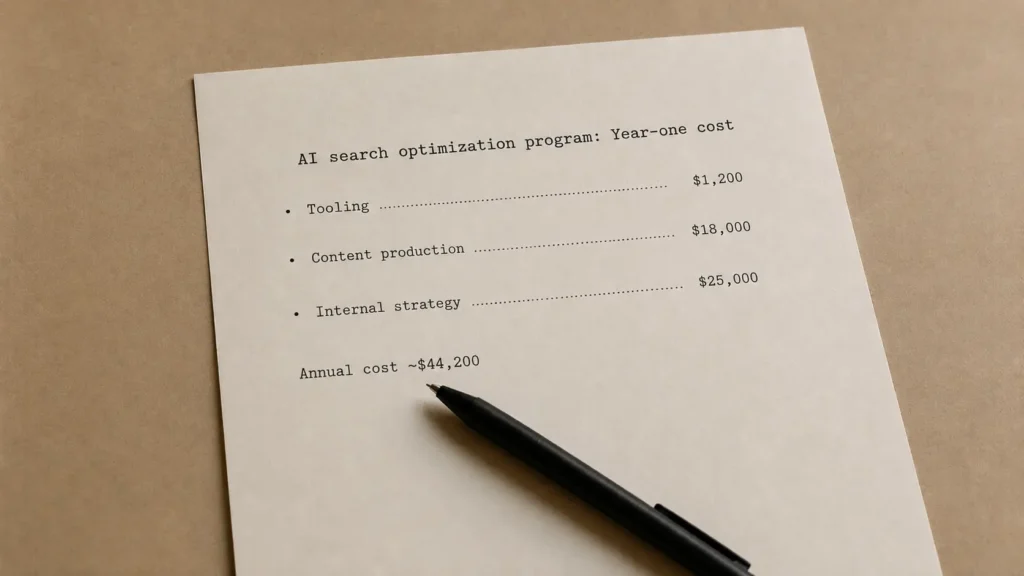
For a growth-stage company doing 2 retrofits per month at $750–$1,200 per piece, the annual production budget is $18,000–$28,800. At 3 retrofits per month with stronger writers, it climbs toward $50,000–$72,000.
The “redirect, not add” thesis matters most at this line item. According to a Yext analysis of 17.2 million AI citations from January 2026 (cited in the AIVO Platform comparison), 86% of AI citations come from brand-managed or brand-influenced sources. A company’s own content estate is the primary lever, which means the spend targets improvement of what already exists, not new content creation on top of an existing calendar.
Line 3: Internal strategic hours
Internal strategic hours are the largest and least-discussed cost. Running the program in-house requires 8–12 hours per week from a content lead for query monitoring, brief development, retrofit prioritization, and performance review. At a fully-loaded cost of $60–$100 per hour for a senior content hire, that is $25,000–$62,400 annually.
This is not a new salary. It is a reallocation of an existing content lead’s time from volume production to strategic optimization. If the company has no content lead, this line item determines whether the program is viable at all, which I’ll address in the “when to wait” section.
Here are the three scenarios:
| Scenario | Tooling | Content production | Internal hours | Annual total |
|---|---|---|---|---|
| Low (existing lead, 2 retrofits/mo, mid-tier tool) | $1,200 | $18,000 | $25,000 | ~$44,200 |
| Mid (existing lead, 3 retrofits/mo, full LLM tool) | $2,400 | $36,000 | $36,000 | ~$74,400 |
| High (dedicated lead at full capacity, 3 retrofits/mo, premium writers) | $3,000 | $54,000 | $62,400 | ~$119,400 |
The high-end number buys a serious in-house program with a dedicated content lead running at full capacity, premium freelance specialists, and full LLM tracking coverage. It is not an agency retainer. For comparison, Digital Elevator’s AEO/GEO pricing guide puts realistic agency budgets at $2,000–$5,000 per month ($24k–$60k annually) before content production costs, which Stackmatix flags as a common omission in agency quotes. The in-house program at the high end matches the cost of the agency option once content production is added, with the difference that the work is owned, the institutional knowledge stays, and the spend redirects rather than adds.
How to build the payback model for your CFO
Start by naming the attribution problem directly. According to BrandViz.AI, approximately 70% of AI-referred visits arrive without referrer headers, landing in direct or unattributed traffic.
Standard GA4 attribution captures only 10–20% of the true financial return from AI citation visibility. The remaining 80% sits in influenced pipeline, branded search lift, and accelerated sales cycles.
GEO operates in zero-click environments like Claude, Google AI Overviews, and Reddit threads, and you can’t track user behavior on platforms you don’t own. The “revenue minus cost over cost” framework does not work here.
That is not a reason to avoid the investment. It is a reason to build the CFO case on leading indicators and influenced pipeline rather than last-click revenue. Three layers do the work.
Layer 1: The leading indicator case. Citation rate and share of AI voice are measurable with tracking tools even when revenue attribution is incomplete. A 90-day goal of appearing in AI responses to 15–20% of target queries is testable and reportable. Treat it as the equivalent of branded search volume: a directional signal that the program is working, not a revenue line.
Layer 2: The shortlist inclusion case. Return to the 6Sense finding. 95% of B2B deals are won by a vendor on the Day One shortlist. If a $5M ARR company closes at an average ACV of $25,000 and converts 1 in 4 shortlisted opportunities, then moving from zero AI citations to consistent visibility on 10 relevant queries corresponds to some number of incremental shortlist inclusions per year. I’m not going to commit to a precise conversion number, because nobody has a verified one. The point is to give the CFO a model they can fill in with the company’s own ACV and close rates: incremental shortlist inclusions × close rate × ACV = pipeline impact. The math is conservative even at modest assumptions.
Layer 3: The SEO baseline case. First Page Sage estimates a median 702% ROI with a 7-month break-even for B2B SaaS. The figure covers content and SEO programs generally, not AI search optimization specifically, and the source itself notes it is a median across a range of companies, not a guaranteed outcome. Present it with that caveat.
The argument for the CFO: an AI search optimization layer added to an existing content engine does not start a new break-even clock. It improves the performance of content already being produced, which means the incremental payback window is shorter than 7 months, not longer.
The whole case, stated plainly: the company is at risk of being excluded from buyer shortlists that form in AI-mediated research, the cost to reduce that risk is $40k–$120k in year one, most of the spend redirects from existing content production, and the leading indicators are measurable inside 90 days even before pipeline impact materializes.
When to wait and when to invest now in AI search optimization
Two conditions mean a head of marketing should not run this program in year one.
The first is being under $2M ARR with no existing content function. The internal hours line item is the largest cost, and it is only a reallocation if there is content work to reallocate from. At that stage, the priority is building the content engine first. Optimization layered on nothing is nothing.
The second is having a content program that is not performing in traditional search. AI engines cite credible, well-structured content. A program producing weak content will not gain AI citations regardless of schema markup or entity optimization. If existing content is not getting indexed, not ranking, and not getting read, the foundation problem comes first. This weakness is also why some content gets retrieved but never cited by AI engines: retrieval depends on indexation; citation depends on quality.
Two conditions mean the program is worth funding now.
The first is being at $2M–$20M ARR with an existing content program producing indexed pages and some organic traffic. At that stage the year-one work is mostly retrofit and reallocation, not net-new spend. The cost ranges in the model above apply directly.
The second is operating in a competitive category where AI-generated shortlists are already shaping buyer consideration. This is testable in 30 minutes of manual prompting in ChatGPT and Perplexity before any budget is committed. Run the queries a buyer would run. See which vendors appear. If competitors are cited and you are not, the directional risk is no longer theoretical.
The recommendation: if the company meets the “invest now” criteria, the program costs less than one senior marketing hire and carries a defensible payback window grounded in real benchmarks. The cost of waiting is not zero. Competitors cited in AI responses today are building shortlist presence that compounds, and a September 2025 academic preprint noted that the field is at “early stages of behavioral shifts.” Early stages are when positioning is cheap.
What the attribution gap actually means for your board presentation
The strongest counter-argument deserves the strongest response. If revenue cannot be attributed to AI citations, can the spend actually be defended? I want to answer that honestly.
The limits are real. As we’ve seen, roughly 70% of AI-referred visits arrive without referrer headers, while standard GA4 attribution captures only 10–20% of the true financial return. The September 2025 arXiv preprint noted that as of that date, no published peer-reviewed studies confirmed that GEO-specific tactics produce measurable AI visibility improvements over general content quality. The evidence base for the category is primarily practitioner-reported and vendor-reported. I will not pretend otherwise.
Now the reframe. Every B2B SaaS company already funds marketing investments with the same attribution gap. Brand advertising, PR, podcast appearances, conference sponsorships, and analyst briefings all operate in zero-click or zero-attribution environments. All of them run on the same “influenced pipeline” logic being applied to AI search optimization here. A head of marketing does not need to solve the attribution problem to make this investment defensible. She needs to show three things: the investment is proportionate to the risk being mitigated, the risk is grounded in real market data (6Sense on shortlist formation, Semrush and Similarweb on AI referral traffic growth), and the leading indicators (citation rate, share of AI voice) are measurable inside the budget cycle even when revenue attribution is incomplete.
The pace question deserves the same honesty. The investment case is not “search is dying.” It is “AI-mediated vendor discovery is a real and growing behavior, confirmed by primary survey data and platform referral traffic figures, and the compounding cost of waiting is non-zero.”
If a CFO pushes back on attribution, the answer is straightforward. PR and brand already run on influenced-pipeline logic. The same logic applies here. The difference is that AI citation visibility has measurable leading indicators that PR and brand do not. A 90-day citation rate movement is visible in tooling reports. That is more accountability, not less, than the marketing investments already on the budget.
Build a defensible AI search budget before your next board meeting
If you’re building this cost model for a real board presentation and want a second set of eyes on the numbers, or if your content program needs a diagnostic pass before the AI optimization layer makes sense, that is the kind of engagement where a fractional content strategist pays back quickly.
Frequently asked questions about AI search optimization cost and ROI
How much does AI search optimization cost for a B2B SaaS company in year one?
For a growth-stage B2B SaaS company at $2M–$20M ARR, a year-one program typically runs $40k–$120k across three components: AI visibility tracking tooling ($1,200–$3,000 annually for growth-appropriate tools like Peec, Otterly, or LLM Pulse), content production uplift ($18,000–$72,000 annually depending on retrofit volume and writer rates), and internal strategic hours from a content lead ($25,000–$62,400 annually at fully-loaded rates). The majority of the spend is internal hours, and much of the content production cost redirects existing budget rather than adding to it.
What AI visibility tracking tools are appropriate for a growth-stage SaaS company?
Tools built for enterprise customers, such as Profound at its higher tiers, are generally overpriced for companies under $20M ARR. Growth-stage alternatives include Peec, Otterly, SE Visible, and LLM Pulse, which provide coverage of ChatGPT, Gemini, and Perplexity at $79–$249 per month. A growth-stage company needs citation tracking and share-of-voice measurement, not enterprise SSO and SOC 2 compliance features that add cost without adding program performance.
What is the ROI of AI search optimization for B2B SaaS?
No verified, primary-source ROI study exists for AI search optimization programs at the growth stage. The best available baseline is the First Page Sage B2B SaaS content and SEO benchmark: a median 702% ROI with a 7-month break-even, measured across programs over three years. An AI search optimization layer added to an existing content program should accelerate that baseline rather than reset it, because the work improves content already producing indexed pages and organic traffic. The honest caveat: approximately 70% of AI-referred visits arrive without referrer headers, so the program’s financial return is better modeled as influenced pipeline and shortlist inclusion than as last-click attributed revenue.
Is AI search optimization worth the investment for a Series A SaaS company?
The answer depends on two conditions. If the company already has a functioning content program producing indexed, credible content, and operates in a category where AI-mediated vendor discovery is already active (testable with 30 minutes of manual prompting in ChatGPT and Perplexity), year-one investment is defensible. If the company has no existing content program, or has a content program that is not performing in traditional search, the priority is building the content foundation first. AI engines cite well-structured, credible, entity-clear content, and optimization tactics will not compensate for weak underlying content.
How do I make the case for AI search optimization spend to a CFO or board?
The most defensible CFO argument is not revenue attribution. It is shortlist risk. According to 6Sense’s 2025 Buyer Experience Report, 95% of B2B deals are won by a vendor already on the buyer’s Day One shortlist, and 94% of buyers now use LLMs during vendor evaluation. A company not cited in AI responses to category queries is at risk of being excluded before the funnel begins. The case to present: the cost to mitigate that risk is $40k–$120k in year one, most of it redirected from existing content spend, and the alternative is ceding early-funnel shortlist presence to competitors investing now.
How long does it take for AI search optimization to show results?
Citation improvements from structural content changes are typically visible within 4–12 weeks of publishing optimized content, based on practitioner reports in the category. The broader pipeline impact, including shortlist inclusion and influenced deals, operates on a longer horizon aligned with the 6–12 month window for content programs generally. The 90-day milestone worth tracking is whether citation rate on target queries has moved from zero or near-zero to 15–20% of monitored prompts. That leading indicator is measurable before revenue attribution is possible.